twc-028 / A study by Syafril · not client work

Saku Dapur: Saku Dapur

A fictional shop workbook for the inside of Toko Saku: inspect saved sample orders, prepare price-less notes, adjust practice stock and read a daily count. Everything stays in one browser; no real accounts, customers, prices or transactions.

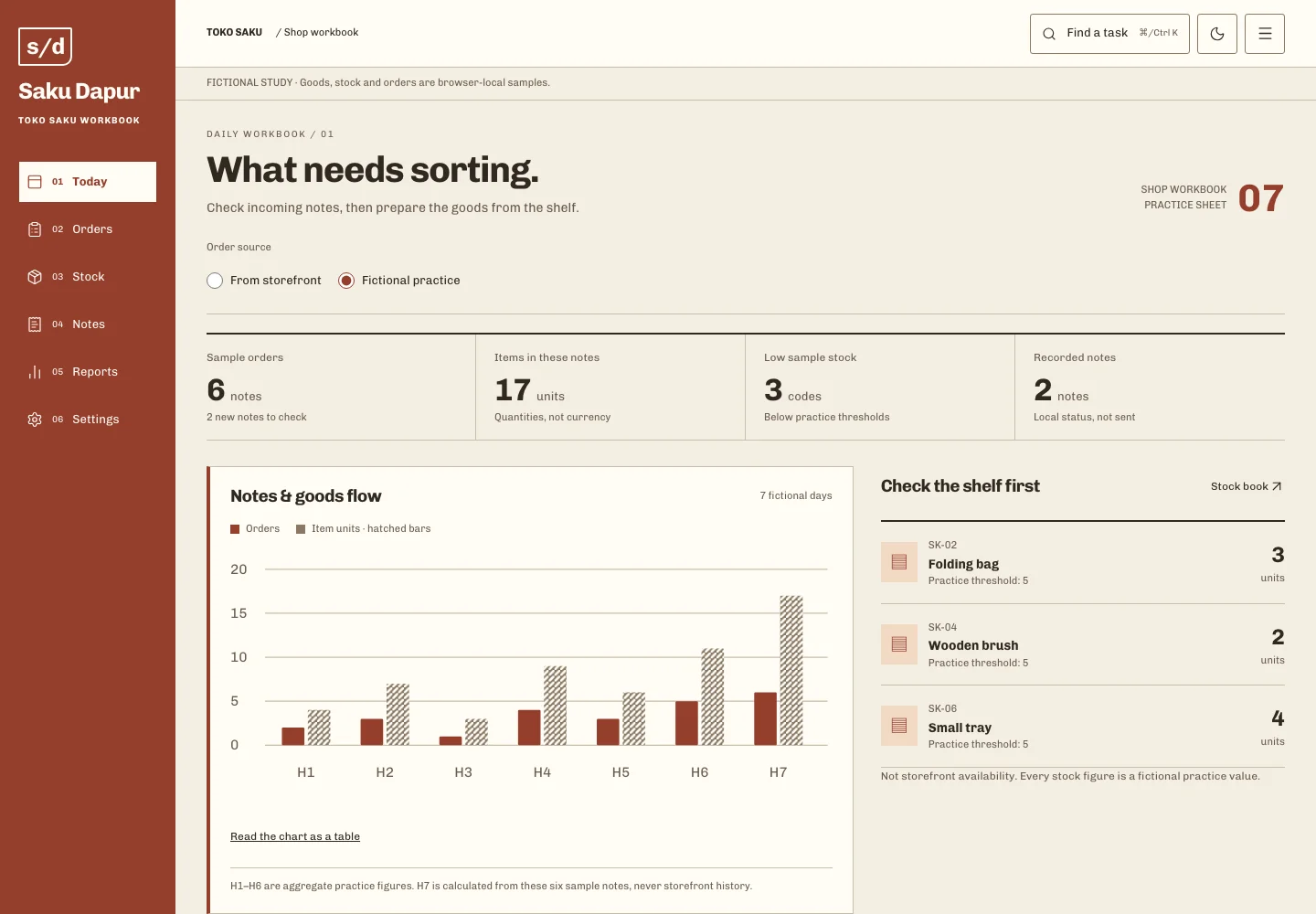
Actual desktop capture of the Saku Dapur demonstration.

READ THE DESIGN

Why it is arranged this way.

The capture shows the implemented opening. Notes connect its composition to the working experience and its mobile behavior.

Actual website capture. Follow the numbered notes.
  1. 01

    The book spine is the index

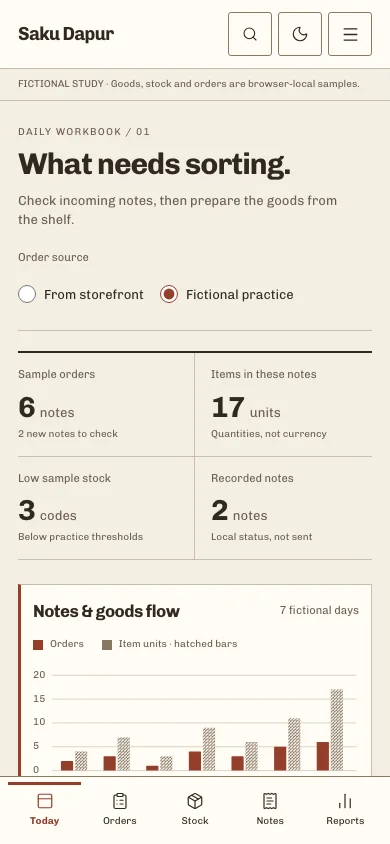
    The brick desktop index names the work, not a collection of generic blocks. On a phone its five daily destinations move to a labelled bottom navigation; settings and the design book remain reachable.

  2. 02

    Counts say what they count

    A ruled strip counts notes and units, never money. Practice and storefront samples have separate sources; no price, payment or available-stock claim enters this sheet.

  3. 03

    A snapshot and its work are different records

    The table opens an intact source note in a scoped detail drawer. Local preparation stages live in a separate workbook, so Toko Saku can continue reading its original v1 snapshots.

At a glance

Headline type
Chivo
Reading type
Chivo
Try this interaction
Inspect a sample note, record local stages, adjust practice stock
Workbook paper#f4eee3
Brown ink#302921
Brick cover#943e2c
Slip paper#fffcf5
Index tint#f2d9c3
Pencil green#355b44
A schematic of the implemented composition.

WHAT IS HERE / WHAT COMES NEXT

Know what you are choosing.

Inspect the work behind one clear shop note.

Working in this demo

  • Explicit practice data or sample orders saved in Toko Saku on the same origin
  • Local order stages, separate immutable source snapshots, stock adjustments and report exports
  • Sample sign-in and recovery screens that never authenticate or send a message
  • Own design book, bilingual controls and browser-local brand personalization

This tool includes a working workspace and its own component book. Its controls operate on local state.
Production integrations to discuss

  • An operational shop system requires separately agreed stock rules, accounts, permissions, server data, transactions, prices, devices and audit procedures.

Exports are generated in your browser. No account, cloud storage or external service is connected.

A limit to plan around

Fictional design study, not an operational ERP. No real customers, prices, payments, deliveries or available stock. Local storage has no cross-tab transaction or server sync; exports remain fictional and are not proof of payment.

Delivery & customization

Page scope, brand assets, content, handover, hosting, costs and support are discussed in a consultation before work begins. The demo is a reference for that conversation.

Prepare a brief for this direction

The idea

The back of a small shop has a different rhythm from its shelf. A ruled stock book and the slips tucked between its pages become the interface: a numbered spine for navigation, a daily sheet for counts, a table of incoming notes and a drawer that keeps each original snapshot intact. Toko Saku prepares the sample; Saku Dapur records the local work around it.

Visual language

Brick cloth, warm paper, brown ink and a green pencil mark. Straight rules organize the workbook instead of stacks of statistic cards. The 192px book index belongs to the desktop; on a phone its five work destinations become a bottom navigation. The detail slip has a firm brick top edge, not the storefront’s serrated receipt.

Typography

Chivo 700 writes the nameplate, sheet titles and counts; Chivo 400 carries table rows, labels and reading text. Both are static Latin WOFF2 files, one weight per file, with tabular figures. No simulated bold and no catalogue face inside the workbook.

Layout & composition

Book index, a compact shop header, the fictional-study line, then the task sheet. A ruled count strip precedes paired bars, the stock check and the incoming-note table. Orders open in a 440px right drawer; on a phone it becomes a full sheet. Search, page selection and task actions remain separate controls.

Motion & interaction

A drawer transition explains where the slip came from; a changed row marks the local update. Optimistic changes roll back when browser storage refuses them. Loading placeholders do not pretend to fetch a server. Reduced motion removes sliding and shimmer while preserving every status message.

Under the surface

Static bilingual App Router pages with browser-only validated data. Toko Saku’s collection-umkm-orders-v1 is read through its existing decoder and never written here. A separate 32KiB workbook keeps local progress and at most 60 stock adjustments; preferences have their own 2KiB key. The six practice notes are enabled explicitly and never mixed with storefront records.

Designed for everyone

Native tables retain captions and sortable headings; selection names its scope. The command palette supports Command/Control K, arrows and Enter. Detail dialogs preserve scope, trap focus and return it after Escape. Forms focus the first invalid field, feedback stays until dismissed, every state has words as well as colour, and both colour modes keep readable text.

Inside the experience

  • Daily sheet with counts, paired bars and a stock check
  • Searchable, sortable tables with page selection and a detail drawer
  • Read-only Toko Saku sample orders; local stages stored separately
  • Six practice stock codes and explicit, validated adjustments
  • Price-less note TXT, browser print and daily-count CSV
  • Command palette, persistent feedback, two modes and local brand

A good fit for

  • Small shop owners who want to inspect a browser-local order and stock workflow before agreeing on an operational system.

Across screens

Actual desktop capture of the Saku Dapur demonstration.
Actual mobile capture of the Saku Dapur demonstration.

A different perspective