twc-030 / A study by Syafril · not client work

Sapa: Sapa

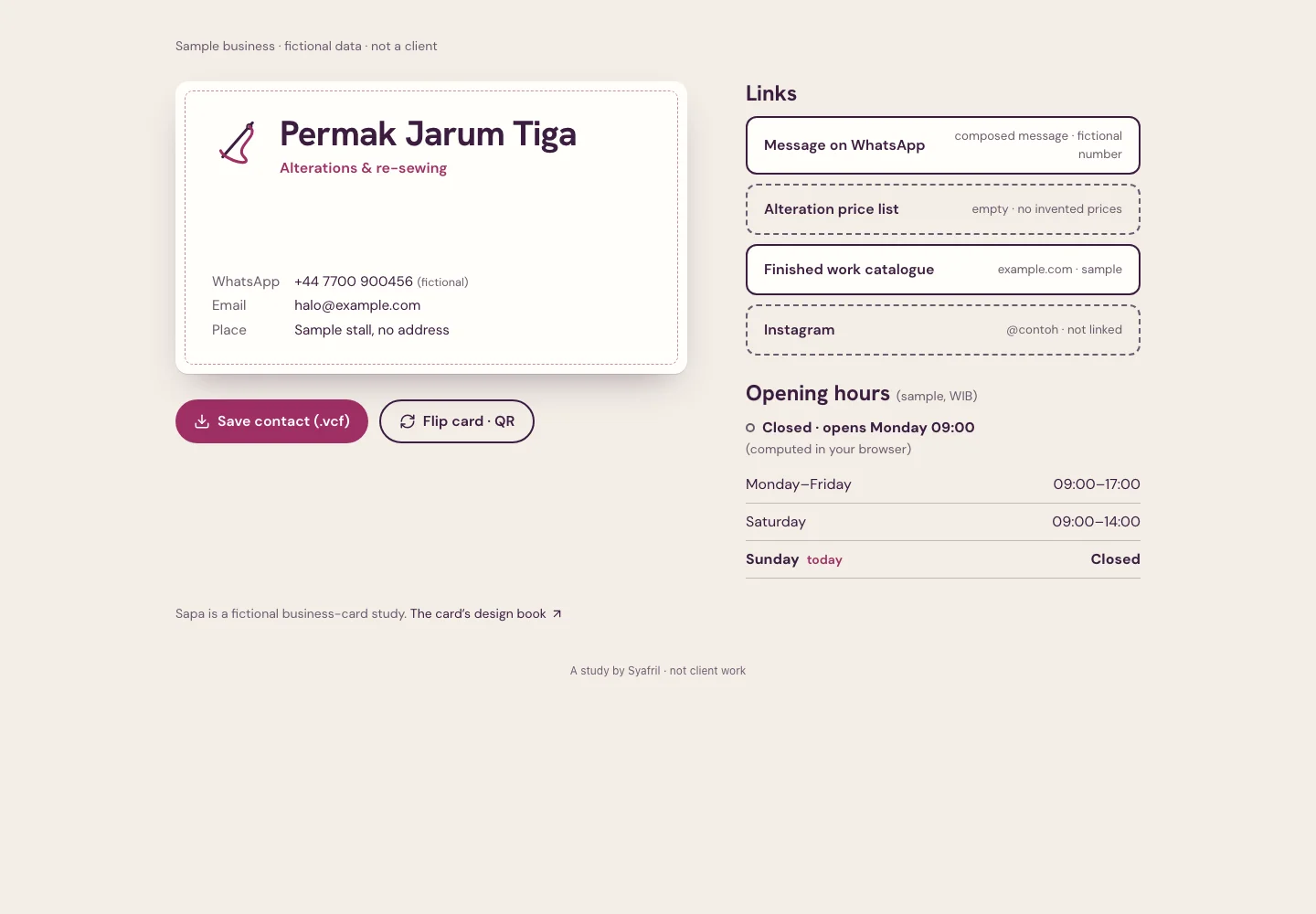
A one-page business card for a fictional alterations stall, Permak Jarum Tiga: tilt the card, flip it to a QR code of this page, save the contact as a vCard, follow its links and see whether it is open now. Every number and address is a labelled sample; there are no prices, reviews or followers.

Actual desktop capture of the Sapa demonstration.

READ THE DESIGN

Why it is arranged this way.

The capture shows the implemented opening. Notes connect its composition to the working experience and its mobile behavior.

Actual website capture. Follow the numbered notes.
  1. 01

    The card is the page

    A printed card’s 1.75:1 face with a stitched edge carries the name, the trade and three contact lines — not an imitation social profile. A visitor’s name and logo replace the sample’s; the contact lines stay labelled samples.

  2. 02

    Its back is this page

    Flip card turns it to a QR code made in the browser from the page address, with the address in text beside it. The card leans toward a pointer or finger and stays flat under reduced motion.

  3. 03

    Links say where they go

    Each framed row names its destination or says it is not linked; the price list is left empty rather than invented. The hours table says in words whether the stall is open now, from Jakarta time.

At a glance

Headline type
Hanken Grotesk
Reading type
DM Sans
Try this interaction
Tilt and flip the card, scan its QR, save the contact
Card stock#f3eee7
Plum ink#3b1d3f
Mulberry thread#9e2f65
Plum tint#e6d6e0
Card face#fffdf9
Muted ink#6b5a6d
A schematic of the implemented composition.

WHAT IS HERE / WHAT COMES NEXT

Know what you are choosing.

One page to hand over, instead of a card.

Working in this demo

  • Tilt by pointer or touch, flip with a toggle button
  • A scannable QR code of the page address, made in the browser
  • vCard 3.0 download with the visitor’s name when a brand is on
  • Open or closed now, from sample Jakarta hours

This tool includes a working workspace and its own component book. Its controls operate on local state.
Production integrations to discuss

  • A real trade’s number, address, price list, catalogue and social accounts, and a domain of its own, need a separately agreed implementation.

Exports are generated in your browser. No account, cloud storage or external service is connected.

1 implemented pages in this theme

See the visual page index

A limit to plan around

Fictional design study. Permak Jarum Tiga does not exist: its WhatsApp number is from a range reserved for drama, its email domain is reserved for examples, it has no address, prices, reviews or followers, and the vCard says it is a fictional sample.

Delivery & customization

Page scope, brand assets, content, handover, hosting, costs and support are discussed in a consultation before work begins. The demo is a reference for that conversation.

Prepare a brief for this direction

The idea

Hand over a card. A small trade is often met through a printed business card passed across the counter; Sapa makes that card the page. Its front carries the name, the trade and three contact lines inside a stitched edge; its back is a QR code of the page itself. Under it sit the trade’s own links and a table of hours that says whether the stall is open now — not an imitation social profile.

Visual language

Plum ink and a mulberry thread on warm card stock: the card face is a shade lighter than the page, with a 1.75:1 printed-card ratio, a dashed stitch inside its edge and a needle-and-thread mark. Links are framed rows, the hours a ruled table; mulberry marks the main action, the stitch and today.

Typography

Hanken Grotesk 700, a compact neutral grotesque like the lettering of a printed card, sets the name, the section titles and the sign, so any visitor’s name still reads. DM Sans carries contact lines, links, hours and buttons with tabular figures. Schibsted Grotesk 700 stays an unused recorded fallback.

Layout & composition

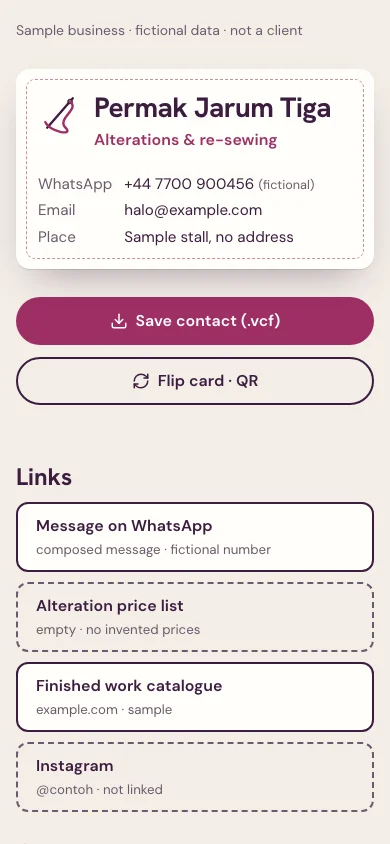
One page. On wide screens the card and its two actions sit left, the links and the hours right. On a phone it reads card → actions → links → hours, with nothing to swipe sideways. Without JavaScript both sides of the card follow each other, the back as the page address in text.

Motion & interaction

The card leans toward the pointer or a finger (at most 8°) and settles back when released; Flip card turns it once to the QR side. The thread of the mark is sewn once as the page loads. With reduced motion the card stays flat, flips without turning and the mark appears whole.

Under the surface

A static bilingual Next.js page. The QR code is encoded in the browser by the theme’s own encoder (byte mode, level M, versions 1–10) from the page address and drawn as SVG in the card’s ink; the vCard 3.0 file is assembled locally. Opening hours are computed from Jakarta time with Intl. No storage beyond the visitor’s brand, no server.

Designed for everyone

Flip card is a toggle button with aria-pressed; both sides stay in the reading order. The QR has a text alternative and the address beside it, so nothing depends on scanning. Links say where they go or that they are not linked; the open-now line is a polite status; today’s row is named in words, not colour.

Inside the experience

  • A business card that tilts and flips to a QR code
  • Save the contact as a vCard (.vcf)
  • Framed links that say where they go
  • Opening hours with an open-now line
  • Own component and state book
  • Local brand personalization

A good fit for

  • Small trades and stalls — tailors, repairers, home kitchens — that want one page to hand over instead of a printed card or an empty profile.

Across screens

Actual desktop capture of the Sapa demonstration.
Actual mobile capture of the Sapa demonstration.

A different perspective